
Founding the Mandurama Reds
Before rugby league reached Mandurama the football of choice was rugby union.

The project’s September post had already become too long! Thank you for a flurry of interest from the Introduction post and especially for a kind donation (more on that soon). My aim for September was to pinpoint the establishment of the Reds and to reach a few new targets for interview. Here is the first part of that—How and when did rugby come to Mandurama and the Blayney district?
I am still seeking potential interviewees for the project. If you’ve a story to share, please reach out!
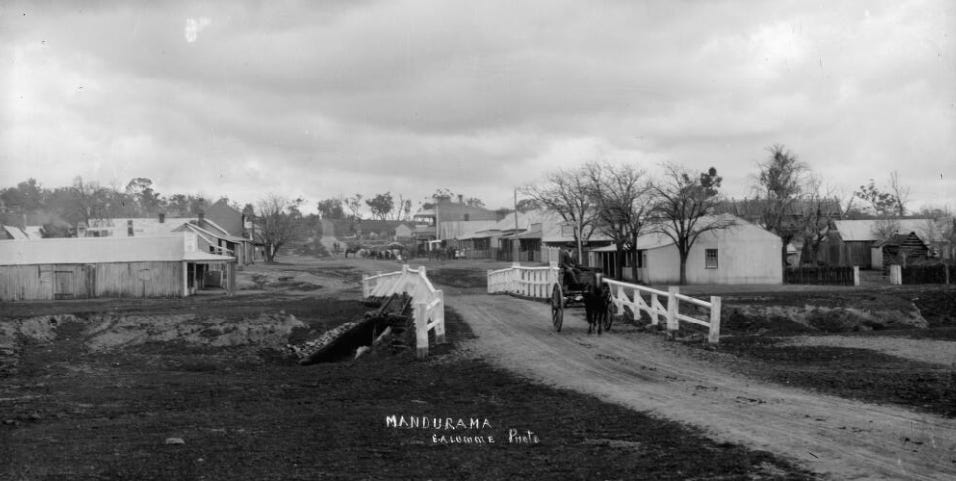
Rugby reached Mandurama, New South Wales, before association football. This is surprising given the simplicity of soccer, but it does reflect the Victorian-era concept of “muscular Christianity” that associated physicality with moral goodness. An idea central to the establishment of bush football. Locally, the first discernible reference to rugby was a meeting held to ‘recognise the Carcoar Football Club.’1 Recognise would suggest that the club already existed and there is more evidence for this some months earlier in The Carcoar Chronicle when a Mr. Lindon Biddulph wrote arguing that the Municipal Council should
make immediate and conclusive arrangements towards securing for public purposes THE ONLY LEVEL AND SUITABLE piece of land available in the Town of Carcoar for cricket, tennis, football and other sports.2
Which, he argued, would be paid in part by ‘collections from the ... Football Clubs’ (plural). Carcoar—then an important regional centre—was already home to at least one rugby club before 1898, but they weren’t alone. In June of that year, as well, it was reported that the Lyndhurst Club had been ‘resuscitated ... but no matches have been played so far.’ The run of The Chronicle doesn’t include a reference to the foundation of the Mandurama Reds but it also isn’t complete. Evidence for the formal establishment of Carcoar and Lyndhurst clubs is strong evidence that Mandurama, too, existed in 1898, if not earlier.
Sydney’s The Sun credits Donald Burke with founding the Mandurama Reds. It was reported in 1926, that ‘he liked the Glebe jersey, and he selected that color [sic] for the players of the little township.’3 I haven’t, however, been able to identify a Donald Burke in Mandurama during the period—at least just yet. The Burke family, however, will figure strongly in this story with Jacky, Sandy, and Cookie Burke amongst the teams first great generation of players. Mandurama’s first recorded match is reported in The Chroncile on 18 August, 1899. Carcoar and Mandurama met in an ‘evenly contested’ match at the former’s ground. Mandurama lost 3-0 with Hines and Willard the first players reported, Hines for a missed penalty kick and Willard for his solid play.4 A popular local priest, Canon Sheddon, ran the touchline.
Although, the first local match recorded was held between Gully Swamp (Gallymont) and Carcoar in 1898. The home team walked away with another 3-0 win and Carcaor with another match scheduled against ‘the Milong Waratahs, of Young,’ for June 11. It highlights the popularity of rugby—not just locally but across the bush—that teams were willing to travel significant distances to play matches. And, that local competitions had yet to be established with teams instead playing ‘scratch’5 and challenge matches (more on the Red’s relationship with challenges matches soon). Sean Fagan’s Rugby Rebellion charts the financial pressures that impacted clubs and players in Sydney. Again, local reporting indicates that these pressures were true as well in the bush where incomes were lower, players harder to come by, and the distances travelled for matches far greater. On 19 July of 1898, despite collecting membership fees from all their players, the Carcoar Club held a Footballers’ Ball in the Academy of Music but the event failed to even pay for itself.6
Despite such pressures, rugby in New South Wales was going from strength-to-strength in the 1890s, although the game was near the crest of a wave ready to break. When new clubs officially formed in centres like Mandurama, Lyndhurst, and Carcaor in 1898 they were following a trend developing in Sydney. Part of an appetite for change that wanted to democratise rugby and would eventually culminate in the formation of a new, rebel sport.
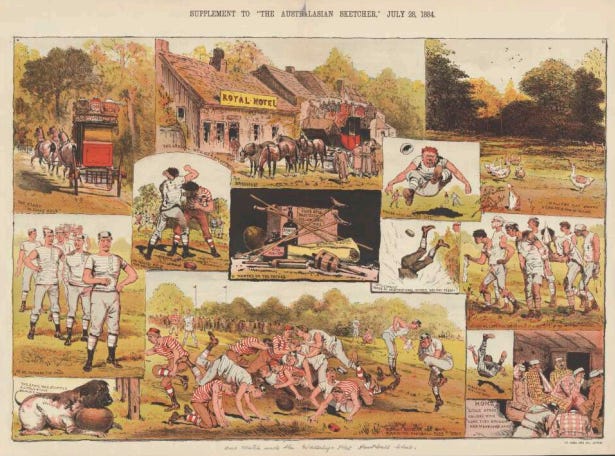
Rugby arrived in Sydney and took hold of the local imagination rapidly. Although the games from which rugby evolved had existed for centuries the sport, as we know it, was codified in the mid-nineteenth century at the Rugby School. When it arrived in New South Wales in the 1870s it was already growing at pace across England—large, formless scrimmaging matches surged across Moore Park attracting large crowds before the decade was out. Rugby spread, as mentioned earlier, with a tone of “muscular Christianity” which was captured in an 1857 description that stated that the purpose of games such as rugby was to ‘try the muscles of men’s bodies, and the endurance of their hearts, to make them rejoice in their strengths’.7 Given the near twenty-year head start that the English game had over New South Wales it is remarkable how quickly the sport caught up in the colony.
In Sydney, rugby formed around “social clubs.” Wallaroos, Waratahs, Pirates: these were clubs based on class first and friendship second--but they weren’t above a quiet payment-in-kind. For a payment-in-kind of course! By 1896, there were 75 clubs associated with the NSWRU.8 Wealthy, gentlemanly players played with their peers at their local club while the best of working-class players were poached and traded with a currency of free boots, better jobs, and waived membership fees. The writing had been on the wall earlier; as soon as crowds were willing to pay to watch Sydney’s best clubs and players it was inevitable that the purely amateur game of rugby could remain one or the other, but not both.
Breaking away from the Rugby Football Union in 1895, the Northern Union formed to allow professionalism into the sport of rugby. Not professionalism recognisable to ourselves today, but a basic semi-professionalism that recognised the labour of players on the pitch, offered bonuses for victory, and supported them when injuries impacted their regular 9-to-5. The problems of amateurism were especially felt in rural NSW, where the travel time and distances were greater and the opportunity for oversight lesser. In Sydney, agitation led to the formation of the Metropolitan Rugby Union in 1898. The MRU reorganised the sport around a district focused competition. The district based model would enable greater numbers of the working class to access the sport of rugby; no longer did you require membership of a social club but you could join a team associated with the suburb you lived, socialised, and raised your family in. Fundamentally, when Australian rugby league was born in 1908, it was based on fairness, equal, and democratic principles. Next time, I’ll focus on documents held by Central West Libraries that detail the arrival of rugby league in the region.
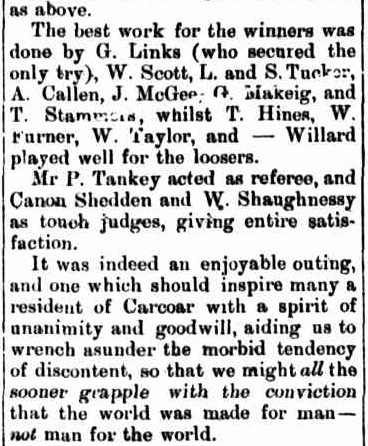
Returning to that August day in 1898, when the Mandurama Reds are first recorded as taking the field. The reported had a closing statement to make on the importance of rugby:
It was indeed an enjoyable outing and one which should inspire many a resident of Carcoar with a spirit of unanimity and goodwill, aiding us to wrench asunder the morbid tendency of discontent, so that we might all the sooner grapple with the conviction that the world was made for man—not man for the world.9
I imagine these words would leave even Phil Gould a little red in the face but they allude to community pride, the importance of faith and its interconnection to sport, and the popularity of the new game of rugby in the Blayney district.
1 The Carcoar Chronicle, 7 January 1898.
2 Ibid.
3 The Sun, 1 September 1926
4 The Carcoar Chronicle, 18 August 1899.
5 The Carcoar Chroncile, 29 April 1898.
6 The Carcoar Chroncile, 29 July 1898.
7Thomas Hughes, Tom Brown’s School Days (1857), https://www.gutenberg.org/cache/epub/1480/pg1480-images.html#link2HCH0005.
8 Sean Fagan, Rugby Rebellion (London: London League Publications, 2005), 21.
9 The Carcoar Chronicle, 18 August 1899.